


Safe at Home trial shows promising early results
Early results from the Safe at Home trial are demonstrating the potential of this innovative response to family violence.
Safe at Home is an early intervention response to family violence aiming to prevent homelessness and further harm. It is delivered through a partnership led by McAuley, with Meli as the primary service delivery partner, and Barwon Community Legal Service, Westjustice and First Step Legal providing critical legal and financial advice.
Safe at Home shifts the focus from women and children being forced to leave their homes to supporting them to remain safely in their homes or communities wherever possible.
The trial is demonstrating that leaving home does not have to be the only pathway to safety for women and children experiencing family violence. Its whole-of-family approach also supports the person using violence to change their behaviour – an important shift from traditional responses that focus primarily on the victim survivor.
“It has changed my life, it is the exact help that I needed and it was available just at the right time for me to be able to leave my abusive relationship and give my daughter and myself a better life.”
– Safe at Home community member
In its first year of operation, the three-year trial in the Geelong and Barwon region has supported 117 individuals from 29 households. It has provided thousands of hours of flexible, coordinated support across safety planning, housing, legal and financial assistance, psychosocial and practical support.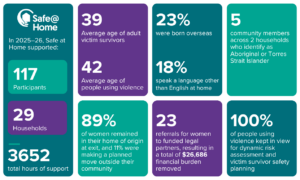 The first year of Safe at Home has provided valuable insights into what is required to implement this approach effectively.
Whole-of-family work in the context of family violence has presented challenges in managing safety and disentangling complex legal and financial matters. Guided by lived experience advisors, the trial partners have worked hard to coordinate a wide range of services needed for each family, whilst maintaining confidentiality between the parties.
The iterative nature of the trial has meant the partners have been able to adapt service delivery as emerging information has become known.
Two of the most recent adaptations have been embedding lived experience expertise in the form of a Peer Worker into the team, as well as a Children and Young People Practitioner. This will strengthen the model’s capacity to provide targeted whole-of-family support, including ensuring the needs and perspectives of children and young people are clearly reflected in the response.
Katie Alexander, a Lived Experience Advocate for Safe at Home who is a member of the trial’s governance group, as well as Co-Chair, Victim Survivor’s Advisory Council, describes her advocacy experience as extraordinary.
“This is one of the most exciting projects I’ve seen. If this had been available for me when I was first going through family violence, we may not have experienced episodic homelessness for the next 18 years,” she said.
“The voices of the lived experience advisors have broadened and deepened the project at key times. We have been involved in this project from the beginning, and our lived expertise complements the academic and clinical skills on the governance group.
“Safe at Home is important because it can save and transform lives immediately. Getting in early and providing that wraparound support – that’s what is unique about Safe at Home. It would have changed my life by reducing the damage of unstable housing, poor legal support and financial abuse. I believe it’s changing other people’s lives.”

